New article published in the International Journal of Disaster Risk Reduction

From local knowledge to global patterns: a cross-cultural study of the dimensions of hazards and adaptive capacity

Samantha K. King, Cynthiann Heckelsmiller, Carol R. Ember, Eric C. Jones, Sebastian Wang Gaouette, Anj Lee Droe, Danielle Russell, Jacqueline Heitmann, Isana Raja, and Michele Gelfand

 In this article, my co-authors and I report some of the findings from our Minerva Research Initiative grant “Response to Shocks and Hazards Associated with Climate” (2022-2024).

Abstract

Understanding the human impacts of environmental hazards is a growing concern. While there is a plethora of research on climate adaptation, the literature is highly fragmented, and empirical studies are rarely carried out with global samples. This lack of comparative work limits our ability to understand general patterns in how societies adapt, thereby impeding effective policy and practice at a wider scale. To fill this gap, we outline a global comparative approach to the study of hazards that uses ethnographic data. The approach operationalizes five ecological dimensions of environmental hazards, including event type, frequency, onset speed, predictability, and severity, and investigates how they relate across a world-wide sample of 132 nonindustrial societies with significant variation in time and space. We then utilize this approach to explore how specific ecological dimensions might influence the adaptive capacity of societies to respond to events. Findings uncover generalizable patterns that exist across our global sample, suggesting that predictability enhances adaptive capacity, while temporal factors that promote uncertainty (including slow onset speed, longer event duration, and unpredictability) limit the success of adaptation efforts.

Keywords

Climate change, Natural hazards, Adaptation, Adaptive capacity, Cross-cultural research, Hazard ecology

https://doi.org/10.1016/j.ijdrr.2025.105950, under a Creative Commons license
New Appointment at Yale University

I am pleased to share that I have accepted a new position as Research Associate at the Human Relations Area Files (HRAF) Advanced Research Centers at Yale University. My work at HRAF will utilize cross-cultural research methods to understand (1) how societies transform in relation to climate stresses and shocks and (2) identify the types of responses that promote and enhance resilience. This research is funded by the Minerva Research Initiative grant “Response to Shocks and Hazards Associated with Climate.”

UPDATE: This grant was abruptly cancelled in 2024 shortly before the Pentagon shut down the entire Minerva program. You can access an archived version of the grant description using the wayback machine.

Dissertation Abstract

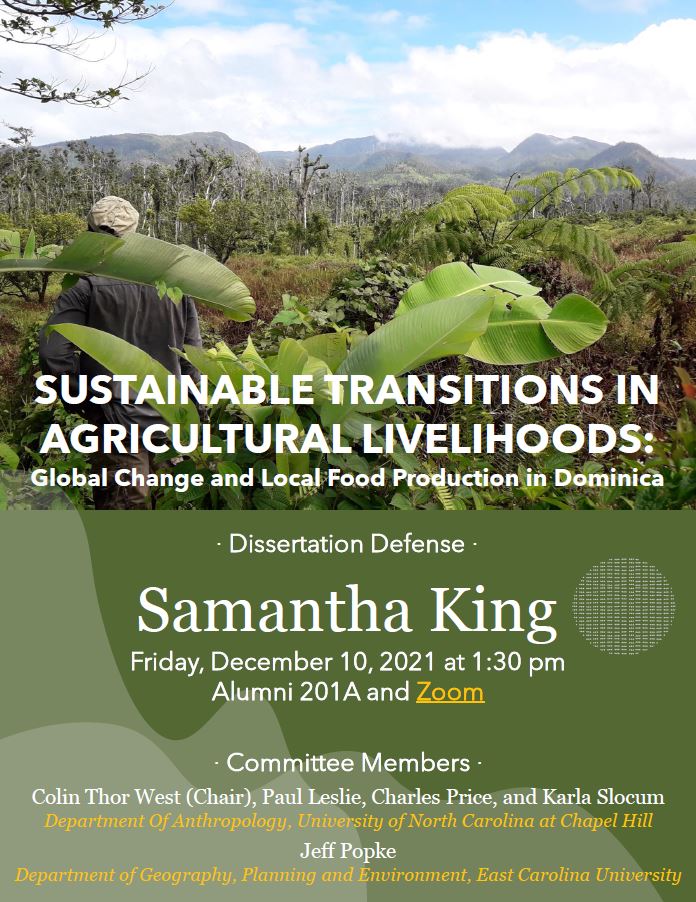
Sustainable Transitions in Agricultural Livelihoods:
Global Change and Local Food Production in Dominica

Samantha King, PhD
University of North Carolina at Chapel Hill
Defended December 2021, Published May 2022

This dissertation provides an ethnographic study of agricultural change in the Commonwealth of Dominica, a small island nation in the Eastern Caribbean. Utilizing a comparative and mixed methods approach, it investigates how smallholding, family farmers are adapting their livelihoods in response to adverse global changes that have (1) eliminated their traditional export markets and (2) produced new climate stresses and shocks, which include two successive national disasters in 2015 and 2017. Whereas most recent research on Caribbean agriculture has focused on general trends of increasing vulnerability and export sector decline, this study details how farmers in Dominica have reorganized their livelihoods toward diverse forms of local food production. It also assesses the varied possibilities of these livelihood transitions to achieve social, environmental, and economic sustainability. To explore the process of rural transformation, the study integrates qualitative, quantitative, and geospatial data from long-term participant observation, a panel survey of households, and participatory GIS mapping in two rural villages. These primary data are combined with interviews of state officials and development practitioners, archival material, statistical data, and policy documents. Findings demonstrate how variation in sustainability outcomes articulates to state policy interventions and processes of economic and environmental change both over the shorter and longer terms. While farmers have devised a range of creative solutions and strategies to attempt to build sustainable livelihoods, institutional legacies of dependence have reproduced an inflexible model of development that both obscures and undermines these local innovations. In documenting the struggles and successes of rural people, this study presents an evidence base from which to build an alternative path for agricultural development in Dominica, one that is grounded in the place-based solutions and perspectives of the farmers themselves.

The full document will be accessible via Proquest after May 2024. In the interim, please contact me directly for requests to access data and results.

Participatory GIS Research Receives National Award

I am pleased to share that my participatory GIS research has been recognized by the National Association for the Practice of Anthropology with a  Student Achievement Award for best original research in an applied context.

While conducting dissertation research in Dominica (2018-19), I engaged in a collaborative project with stakeholders in my research communities to build local capacity in geospatial technologies. Participants in this project learned how to collect and record spatial data and make digital maps using GIS technology. This effort is detailed in my forthcoming Practicing Anthropology article “GIS as a bridge across the digital divide: Engaging participatory methods to build capacity in research communities“.

Research Featured in Dominica Geographic

I’m thrilled to have my photographs and words featured on the cover of the latest issue of Dominica Geographic, Climate Edition. My article, “Seeds of Change: Farming Traditions and Climate Futures,” discusses the complex challenges farmers in Dominica face due to the combination of chronic economic problems and new climate variability.

Download the article as a PDF or visit the Dominica Geographic archives to access the complete magazine.


Digital Dissertation Fellowship

I am pleased to share that I have been awarded a Digital Dissertation Fellowship through the Carolina Digital Humanities Initiative at the University of North Carolina at Chapel Hill. This support will enable me to integrate many of the diverse data sources I have collected during fieldwork in Dominica and incorporate them into an online, interactive story map. The story map will explore how Dominica’s history and rural traditions are being utilized by farming communities to build alternative agricultural livelihoods in diverse forms of local food production.

PEO Scholar Award

I am pleased to share that I have received a PEO Scholar Award, which will fund my dissertation research for the 2018-19 academic year. I am thrilled to be joining this prestigious community of women scholars!